Ultra Low Gloss (ULG) Metal Roofing and Siding: What It Is, Why It's Trending, and When It's the Right Call

Walk any new subdivision, barndominium build, or modern farmhouse remodel right
now and you'll see the same thing: flat, matte-black metal roofs and dark board and batten siding with almost no shine to them. That look comes from an Ultra Low Gloss coating, usually shortened to ULG.
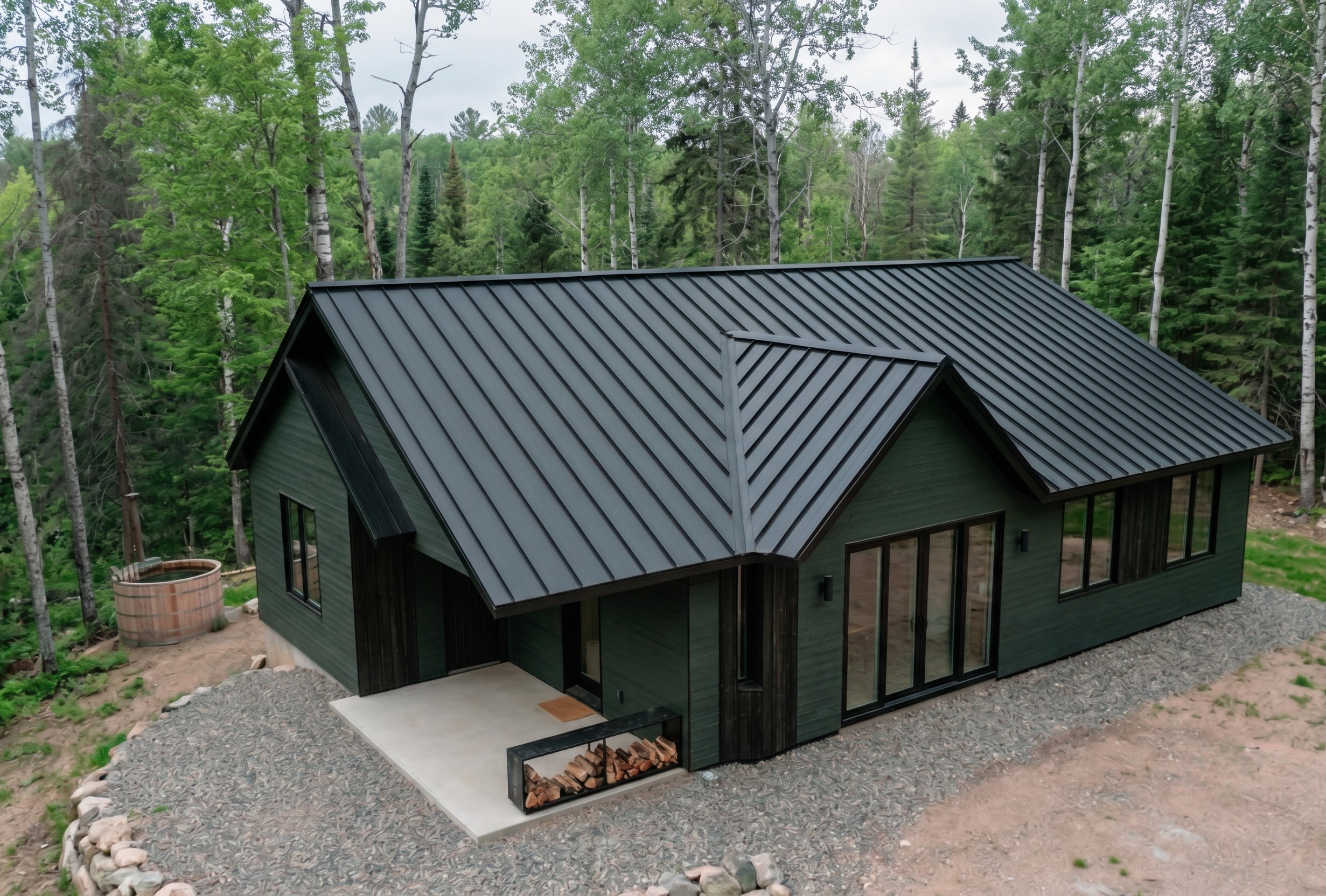
It's one of the fastest-growing requests we get, and it's also one of the most misunderstood. ULG isn't a different kind of paint, it isn't a texture, and it isn't automatically more durable or less durable than a standard finish. It's a gloss level. Here's what that actually means for your roof or your walls.
What "gloss" means on a metal panel
Gloss is a measurement, not an opinion. Coating manufacturers put a gloss meter on the panel and shine a light at it at a fixed angle, usually 60 degrees, then measure how much of that light bounces straight back. The higher the number, the shinier the panel.
Rough ranges for painted steel:
Finish level | Typical 60° gloss reading | What it looks like |
Standard metal roofing finish | ~25–35 | Noticeable shine in direct sun |
Low gloss | ~10–15 | Soft sheen, mild reflection |
Ultra Low Gloss (ULG) | Under ~10 | Flat, chalkboard-like, almost no reflection |
That single change, dropping gloss from the high twenties down into the single digit, is the whole product. Same steel, same substrate, same coating chemistry family. The paint formulation just includes flatting agents that scatter light instead of reflecting it back at you in one direction.
Why builders and homeowners are asking for it
1. It hides oil canning
This is the big one, and it's the reason we recommend ULG on certain profiles regardless of the aesthetic.
Oil canning is the slight waviness you sometimes see in the flat areas of a metal panel. It's an inherent characteristic of light-gauge formed metal, not a defect, and not something any manufacturer can eliminate entirely. But how visible it is depends almost entirely on how the panel handles light. A glossy panel acts like a mirror. Any waviness in that mirror shows up as a distorted reflection, and your eye catches it instantly from the driveway.
A ULG panel doesn't reflect a clean image, so there's nothing to distort. The waviness is still physically there. You just can't see it. On wide, flat areas, standing seam, long fascia runs, single-skin wall panels, that difference is dramatic.
2. It kills glare
A large south-facing metal roof in full sun throws a lot of light. If your neighbor's house sits below yours, or you've got a lot of glass facing the roof plane, glare is a real complaint. ULG solves it. Same story for commercial buildings near roadways.
3. It reads as a modern, high-end finish
Matte finishes have taken over exterior design for the same reason they took over cabinetry and appliances: they look intentional and understated. A flat black standing seam roof over white board and batten siding is probably the single most requested combination in residential metal right now, and gloss is what separates a build that looks current from one that looks like a 2010 pole barn.
4. Dark colors look deeper
This one surprises people. Straight-on, a matte dark color can look flatter and less rich than its glossy version. But at an angle and in shifting daylight, a ULG dark gray or black holds its depth instead of blowing out into a bright reflection. Dark colors are where ULG earns its keep. Light colors show much less difference.
What ULG doesn't change
Let's be direct about this, because there's a lot of marketing noise around matte finishes.
Gloss level is not a durability rating. Fade and chalk resistance come from the resin system, the coating chemistry, not from how shiny the panel is. A ULG panel in a premium resin system is a premium panel. A ULG panel in a cheap resin system is a cheap panel that happens to be flat. Ask what the coating system is, not just what the gloss level is.
ULG is not a "cool roof" feature. Solar reflectance is driven by color and pigment technology, not gloss. A matte black roof absorbs about as much heat as a glossy black roof. If energy performance matters on your build, look at the SRI value for the specific color, not the sheen.
It's not a texture. ULG panels are still smooth to the touch. Textured and crinkle finishes are a separate product category that also happens to be low gloss — worth knowing if you're comparing samples from multiple suppliers.
The honest tradeoffs
We'd rather tell you this up front than field the call later.
Handling marks show more. A flat surface scuffs more visibly than a glossy one, and marks don't wipe off as easily. That means gloves on during install, clean lifting instead of dragging panels off the stack, and keeping the panel surface off gritty ground. Sloppy handling shows on ULG in a way it doesn't on standard gloss.
Touch-up is harder to blend. Paint pens and touch-up paint tend to dry with more sheen than the surrounding panel. On a glossy roof, a small touch-up disappears. On ULG, it can leave a shiny dot. Best practice is to avoid needing touch-up at all: pre-drill where required, sweep metal filings off the panel the same day, and cut with a shear or nibbler rather than an abrasive blade.
Color options are usually narrower. ULG lines typically run a curated set of colors rather than a full palette, heavy on blacks, charcoals, grays, bronzes, and earth tones, which is where the demand is.
Order the whole job at once. This is true of any painted metal, but it matters more on flat finishes: run-to-run color variation between separate production batches is normal and isn't grounds for a claim. Get your quantities right, add your waste factor, and buy it in one shot. Mixing batches on the same elevation is asking for a visible seam.
Where we'd actually specify ULG
Standing seam roofs on steep, highly visible slopes. Maximum oil canning benefit, maximum curb appeal payoff.
Board and batten and plank-style siding. The flat finish reads like painted wood instead of like metal, which is usually the goal.
Wide fascia and soffit runs. Long flat planes at eye level are the worst case for visible waviness.
Anywhere glare is a complaint. Roofs facing neighbors, roadways, or large window walls.
Where we'd think twice: agricultural and utility buildings where panels get handled hard and scuffed, and light-colored jobs where you're paying for a difference nobody will notice from the ground.
See it before you commit
Gloss is impossible to evaluate on a screen. Every color chart in the industry, ours included, is showing you a photograph of a finish under one lighting condition. A ULG sample and a standard-gloss sample of the same color can look nearly identical online and completely different in your hand.
Get physical samples of both, take them outside, and look at them at different times of day and from different angles. That's the only way to make this call.
Request free color samples at truemetalsupply.com/colors, or call us at 888-455-8783. We roll-form to order from American steel, ship same or next day on most orders, and back the panel with a non-prorated lifetime warranty.